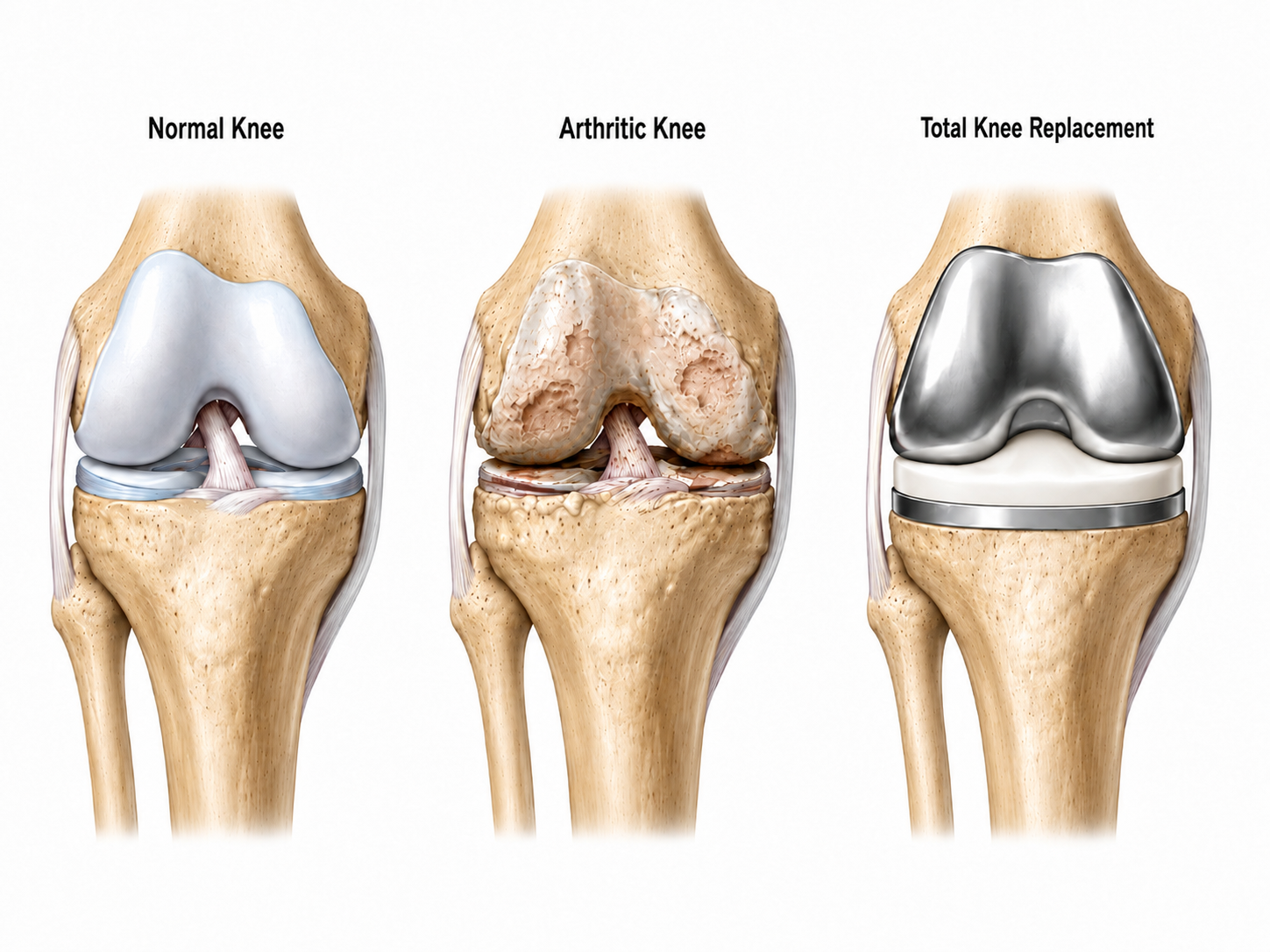
Normal knee, arthritic knee and total knee replacement compared, showing cartilage loss and the metal and plastic implant

Knee Replacement Surgery: Six Essential Facts

  • What does knee replacement involve: The worn knee joint surfaces at the end of the thigh bone and shin bone are replaced with artificial components, with a plastic bearing between them
  • When is it considered: When pain, stiffness, loss of function or deformity is significantly affecting quality of life, and appropriate non-surgical treatment has not helped enough or is unsuitable, I consider a potential total knee replacement.
  • Reported improvement: Around 90 in 100 report improvement; 72.8% of patients reported symptoms much better, and 16.8%reported little improvement (NHS England, 2024/25).
  • How long implants last: The National Joint Registry reports that most knee replacement patients have less than a 5% chance of revision within 13 years.
  • Recovery: Walking usually begins soon after surgery. Many patients go home within one to three days, although full recovery takes several months (up to 1 year).
  • Important risks: These include infection, blood clots, fracture, and nerve injury. BOA and BASK standards note that around 10–20% of patients report persistent pain, stiffness, or dissatisfaction with one or more of these problems


The knee is formed mainly by the lower end of the thigh bone (femur), the upper end of the shin bone (tibia) and the kneecap (patella). Smooth cartilage normally allows these surfaces to move with little friction. Osteoarthritis gradually changes this cartilage and the underlying bone. The joint may become painful, stiff or swollen, and the leg may become bowed or knock-kneed as arthritis progresses.

Common symptoms include:

  • pain with walking or stairs, and difficulty standing from a chair
  • stiffness after rest, and pain that disturbs sleep
  • swelling, grinding or a feeling of giving way
  • reduced confidence with work, exercise or everyday tasks

Symptoms do not always match the severity seen on an X-ray. NICE says osteoarthritis is often diagnosed clinically and that routine imaging is not always needed to make the diagnosis.

For some patients with arthritis that predominantly affects only one part of the knee, a partial joint replacement may be an alternative.

NICE recommends considering referral for joint replacement when symptoms such as pain, stiffness, reduced function, or progressive deformity are substantially affecting quality of life and non-surgical management has been ineffective or unsuitable. The decision should be based on clinical assessment rather than an arbitrary numerical score.

  • Pain, stiffness, or loss of function matters to you, even with appropriate treatment.
  • The history and examination are consistent with knee joint disease, with imaging used where appropriate.
  • You understand what surgery can and cannot achieve, and the rehabilitation commitment is acceptable to you.
  • Your medical health has been assessed, and modifiable risks have been addressed where possible.

BOA, BASK and GIRFT good-practice guidance also emphasises adequate consultation time, a clear and documented consent discussion covering implant choice, and pre-admission assessment as part of a well-run knee replacement pathway.

NICE specifically advises that people should not be excluded from referral for joint replacement solely because of age, sex or gender, smoking, other medical conditions, or overweight and obesity. These factors can still affect your personal risk of surgery, so optimisation and an individual discussion remain important — but they are not automatic barriers to assessment. A BMI cut-off policy of 40 for elective joint replacement surgery is currently in place for Swansea Bay University Health Board. These patients are referred to the weight management team after being assessed, in appropriate cases. These considerations are a broad outline I use when considering surgery for a patient.

Non-surgical treatment can remain worthwhile whether you are avoiding surgery, waiting for surgery or preparing for it. A combined plan is usually more effective than relying on a single treatment.

Exercise and activity

Therapeutic exercise is a core treatment. NICE recommends exercise tailored to the individual, including local muscle strengthening and general aerobic fitness. Symptoms may temporarily worsen at the start of exercise, but regular, long-term exercise can reduce pain and improve function. Supervised exercise can be considered if useful.

Weight management

If you are living with overweight or obesity, weight loss can reduce pain and improve physical function and quality of life. NICE advises that any weight loss can help and that, where achievable, losing around 10% of body weight is likely to give more benefit than losing 5%.

Medicines, injections and walking aids

  • A topical anti-inflammatory medicine (NSAID) is recommended for knee osteoarthritis when medication is needed.
  • If topical treatment is ineffective or unsuitable, an oral NSAID may be considered after reviewing stomach, kidney, liver and cardiovascular risks; gastroprotection is usually needed alongside it.
  • Paracetamol and weak opioids are not routinely recommended, except for infrequent short-term use when other options are unsuitable or ineffective. Strong opioids are not recommended for osteoarthritis.
  • A corticosteroid injection can be considered for short-term relief when other medicines are ineffective or unsuitable, or to support exercise. NICE advises explaining that the benefit is usually short-term, around 2–10 weeks.
  • A walking stick or other walking aid can improve confidence and function for some people.

Treatments not routinely recommended

NICE does not recommend hyaluronan injections, glucosamine, strong opioids, acupuncture or dry needling, or arthroscopic lavage and debridement for osteoarthritis. However, some patients have reported symptom improvement after hyaluronan injections, although evidence remains evolving. Braces, insoles, tape or supports are not routinely advised unless there is a specific biomechanical or stability problem and an aid is likely to improve function.

If you decide to wait

Knee osteoarthritis is not usually dangerous. Symptoms may stay similar, fluctuate or worsen. Continue the agreed exercise and symptom-control plan, and ask for reassessment if pain, sleep, walking, deformity, or independence change. Non-surgical measures can relieve symptoms and delay surgery, but they do not reverse established joint damage. Choosing not to have surgery is a valid decision.

Surgery

Through an incision at the front of the knee, the surgeon removes a small amount of damaged bone and cartilage from the end of the femur and the top of the tibia. Metal components are positioned on these surfaces, and a highly durable plastic bearing sits between them. If the patella is resurfaced, a separate component is attached to the back of the kneecap. The components are commonly fixed with bone cement, although implant choice and fixation depend on the prosthesis, bone quality and clinical circumstances.

Anaesthesia and pain relief

NICE recommends offering a choice of regional anaesthesia (usually spinal) or general anaesthesia, combined with local infiltration analgesia around the knee. A nerve block that does not significantly weaken the leg may also be considered. Your anaesthetist will discuss the options and your individual risks.

Blood loss, infection prevention and implant safety

NICE recommends tranexamic acid for primary elective knee replacement to reduce blood loss, with the dose and route adjusted based on kidney function. Antibiotic prophylaxis and surgical-site infection precautions are used around the operation. NICE also recommends ultra-clean air ventilation for elective joint replacement and two intraoperative pause points to verify implant details and component compatibility.

Documentation and traceability

BOA, BASK and GIRFT best-practice standards set out what should be recorded for every knee arthroplasty: the consent discussion and implant choice, the WHO surgical safety checklist, the alignment and component sizes used, soft-tissue balancing and stability before closure, the drugs given, and the post-operative rehabilitation and clot-prevention plan. The same guidance emphasises careful preoperative planning and the use of knee implants with a proven track record or a rigorous formal evaluation process.

No operation is risk-free. Your surgeon and anaesthetist should explain which risks matter most to you, considering age, frailty, smoking, diabetes, weight, heart, lung and kidney disease, medicines, previous surgery and bone quality.

Expected or usually temporary effects after a Total Knee Replacement
  • A total knee replacement is often associated with significant pain in the early postoperative days, associated with swelling of the knee. It can also lead to fatigue and lack of sleep.
  • Scar tenderness and often a numb or altered-feeling patch of skin on the outer aspect of the knee.
  • A need for walking aids and help with some everyday activities for a period.

Important Total Knee Replacement-specific risks

Infection

A superficial wound problem may settle with treatment. Deep infection around the implant may require a washout, prolonged antibiotics, or revision surgery. NJR patient information describes infection after joint replacement as rare, occurring in fewer than 1% of cases.

Persistent pain, stiffness or dissatisfaction

A proportion of patients continue to have symptoms despite a technically satisfactory replacement. BOA and BASK standards cite 10–20% of patients reporting pain, stiffness, or dissatisfaction.

Stiffness, poor bending or straightening of the knee after total knee replacement

Some people develop significant stiffness despite rehabilitation. Additional physiotherapy, manipulation under anaesthetic or another procedure is occasionally needed.

Fracture

The femur, tibia, or patella can fracture during or after surgery, particularly following a fall resulting in a periprosthetic fracture. These may require fixation or a revision surgery of the existing knee replacement.

Blood clot: Deep Vein Thrombosis(DVT) or Pulmonary Embolism(PE)

Early mobilisation and preventive medication reduce, but do not remove, the risk.

Nerve or blood-vessel injury

Nerve injuries are particularly associated with knee arthritis with significant deformity (predominantly with a knock-knee deformity); they can present with early foot drop or numbness on the top of the foot. Injury to the blood vessel is rare and can be a serious complication.

Ligament, tendon or kneecap problems

Instability, extensor mechanism injury, patellar pain, or tracking problems can occur and sometimes require further treatment.

Complex regional pain syndrome

A rare pain condition that can cause disproportionate pain, swelling, stiffness and sensitivity, and may require specialist treatment.

Wear, loosening or implant failure

A replacement may eventually require revision surgery. The NJR states that most knee replacement patients have less than a 5% chance of revision within 13 years, although risk varies with age, implant, diagnosis and activity.

General surgical and medical risks
  • Bleeding, haematoma or the need for a blood transfusion.
  • Urine retention or urinary infection, chest infection, kidney problems, medication reactions or pressure damage to skin.
  • Heart attack, stroke, serious anaesthetic complication or death. These are uncommon, but personal risk is higher with some medical conditions.

  • Attend pre-operative assessment and give the team a complete list of medical conditions, allergies, medicines, supplements and previous anaesthetic problems.
  • Do not stop blood thinners, diabetes medicines, steroids or immune-modifying treatment unless the surgical team gives you a specific plan.
  • Build strength and stamina within your limits. NICE recommends preoperative rehabilitation advice covering exercise, lifestyle, diet, weight management and smoking cessation.
  • If you smoke, stopping reduces wound, lung and infection risks. Ask for NHS stop-smoking support if needed.
  • If you have diabetes, good blood-glucose control helps reduce complications. Anaemia, poor nutrition and dental infection should be addressed where possible.
  • Tell the team about fever, a new infection, broken skin, ulcers or a worsening wound before admission. Keep the leg skin clean with 2% Chlorhexidine wipes (off-the-shelf) for 2-3 days before surgery.
  • Shower or bathe as instructed. Do not shave or wax the operation area unless specifically told to do so; hospitals use safe hair-removal methods if needed.
  • Prepare your home: clear trip hazards, consider chair and bed height, put frequently used items within easy reach, plan meals, arrange transport and identify someone who can help during the first days.
  • Practise using crutches or a frame beforehand if the physiotherapist offers this.

This guide is independently written for patient education. It summarises guidance rather than reproducing guideline text. Guidance and national data were checked on 30 August 2026.

  1. NICE NG226. Osteoarthritis in over 16s: diagnosis and management. Published 19 October 2022.
    nice.org.uk/guidance/ng226
  2. NICE NG157. Joint replacement (primary): hip, knee and shoulder. Published 4 June 2020. Shared decision-making, prehabilitation, anaesthesia, tranexamic acid, infection prevention, partial versus total knee replacement, patella resurfacing and rehabilitation.
    nice.org.uk/guidance/ng157
  3. NICE QS206. Joint replacement (primary): hip, knee and shoulder quality standard. Published 29 March 2022.
    nice.org.uk/guidance/qs206
  4. NICE NG89. Venous thromboembolism in over 16s: reducing the risk. Elective knee replacement prophylaxis options; evidence reviewed September 2024 with no update required.
    nice.org.uk/guidance/ng89
  5. BOA / BASK / GIRFT. Best Practice for Knee Arthroplasty Surgery Documentation. 2019. Standards for consent, implant traceability, intraoperative assessment and post-operative planning.
    boa.ac.uk/resource/best-practice-knee-arthroplasty.html
  6. BOA / BASK BOAST. Investigation and Management of Patients with Problematic Knee Replacements. August 2020. Notes that 10–20% report pain, stiffness or dissatisfaction, and recommends consultant-led assessment.
    boa.ac.uk/standards-guidance/boasts.html
  7. British Orthopaedic Association. Providing a Continuous Safe Elective Orthopaedic Environment. February 2021.
    boa.ac.uk
  8. National Joint Registry. Patient information on knee replacement, including implant longevity and revision information.
    njrcentre.org.uk/patients/knee-replacement
  9. NHS England Digital. [MI] Patient Reported Outcome Measures (PROMs) in England, Final 2024/25 data. Published 2 April 2026; released as management information, findings to be treated with caution.
    digital.nhs.uk — PROMs final 2024/25 data
  10. NHS England. Decision support tool: making a decision about knee osteoarthritis.
    england.nhs.uk — knee osteoarthritis decision support tool
  11. National Joint Registry. Patient Decision Support Tool (hip and knee).
    njrcentre.org.uk/patients/patient-decision-support-tool