
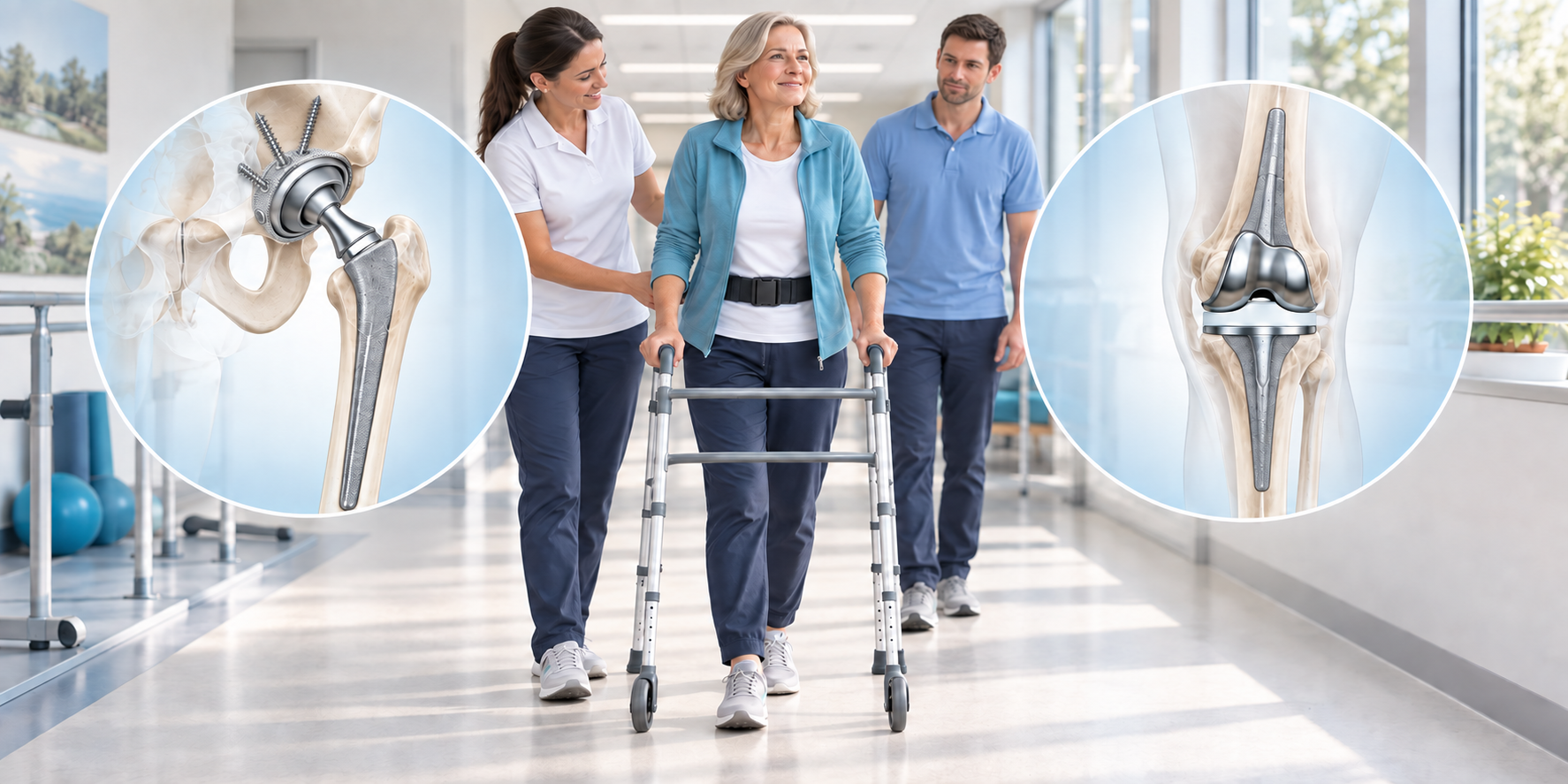
Recovery after revision hip and knee replacement
Recovery after revision surgery follows the operation that was performed, not a calendar. This page explains what shapes it, what to expect week by week in broad terms, and what should prompt a call.
Recovery plan and weight-bearing
A recovery plan built around you
Recovery after revision surgery is planned around the individual patient. That is not a caveat on this page. It is how this surgery works.
Guides to first-time hip and knee replacement can give reliable week-by-week figures, because most patients follow a similar path. Revision covers a far wider range of operations. One patient has a worn plastic bearing exchanged and is walking normally within weeks. Another has a reconstruction built on very little remaining bone, and protects it for months. A single timetable would serve neither of them well.
Your plan is therefore built from your operation, your circumstances and what you need to get back to. It is set out for you by the team who carried out the surgery, and those instructions always take precedence over general information, including this page. What follows explains the factors that shape the plan, so that the advice you are given makes sense.
The four things that shape your recovery
- What was done. A single component exchange and a full reconstruction are different operations with different recoveries.
- How much weight you may put through the leg. This is the single biggest determinant of the first few months.
- Whether infection was being treated. Treatment continues well beyond the operation.
- Where you started from. Strength, general health and how long the joint was troublesome beforehand all matter.
Weight-bearing: the instruction that matters most
Before you go home you will be told how much weight you may put through the operated leg. This is decided in theatre, once it is clear how secure the fixation is and whether graft or reconstruction needs protecting.
| Instruction | What it means in practice |
|---|---|
| Full weight-bearing | Put as much weight through the leg as comfort allows. Aids are used for balance and confidence, not to unload the leg. |
| Partial weight-bearing | Take a defined share of your weight through the leg. The physiotherapist will show you how much that feels like using scales. |
| Touch weight-bearing | The foot rests on the floor for balance only. Almost no load goes through the leg. |
| Non weight-bearing | The foot does not touch the floor at all when standing or walking. |
Restrictions are lifted in stages, guided by how the bone and fixation are healing on X-ray rather than by dates in a diary. National guidance encourages surgery that allows unrestricted weight-bearing wherever the fixation makes it safe, because getting up and moving early protects against chest infection, clots and loss of muscle.6 That is the aim, but it is not always achievable, and a restriction is never applied without good reason.
In hospital, pain and wound care
In hospital
You will usually be helped out of bed on the day of surgery or the day after. Early movement is encouraged even when weight-bearing is restricted, because the rest of the body still needs to work.
While you are in hospital the team will manage pain relief, check the wound, monitor blood counts, start or restart medicines that prevent clots, and begin physiotherapy. If infection was treated, the microbiology team will review the antibiotic plan as culture results come back.
How long you stay
Longer than after a first-time replacement, and longer again for complex reconstructions. Revision surgery is not day-case surgery under any circumstances. Discharge depends on being comfortable on the prescribed medication, safe on the stairs or with the equipment you have at home, and medically stable, rather than on reaching a particular day.
Pain
Discomfort after revision settles more slowly than after a first replacement. The operation is longer and more tissue is disturbed. Most patients find the first week or two demanding and then notice steady improvement.
Pain relief is planned in advance with the anaesthetic team and adjusted individually. It is usually reduced in steps rather than stopped suddenly. Take it regularly at first, particularly before physiotherapy, as trying to manage without it tends to slow progress rather than speed it.
The wound
Revision incisions are often longer than the original scar, and are sometimes placed through or alongside it. Healing can take a little longer where skin has been operated on before.
Keep the dressing dry and intact and leave it undisturbed unless you are told otherwise. Do not apply creams or ointments to a healing wound. Showering is usually allowed once the wound is dry and sealed, but baths, swimming pools and the sea are avoided until healing is complete.
Contact the team the same day if
- The wound leaks fluid, or a dressing becomes soaked
- Redness spreads outwards from the wound
- The joint becomes hot, or suddenly far more painful
- You develop a temperature, shivering or feel generally unwell
- The calf becomes painful, swollen or tender
- You become short of breath or develop chest pain — this needs 999
Wound leakage after revision surgery is never ignored. Early assessment gives the best chance of dealing with a problem before it becomes established.1
Preventing blood clots
Preventing blood clots
Revision surgery carries a higher risk of deep vein thrombosis than first-time replacement, because the operation is longer and mobility is often more restricted afterwards. Prevention combines early movement, calf exercises, good hydration and medication.15
Your thromboprophylaxis plan
The plan is tailored to your weight-bearing status and your mobility, and can often continue for up to six weeks. The more restricted your movement, the longer protection is generally needed.
If you already take an anticoagulant, you will normally restart your usual medication within 24 to 48 hours of surgery, provided there are no signs of bleeding and the wound dressing is reasonably dry.
Take the medication for the full course even once you feel well, and keep up the calf exercises and regular short walks within your permitted limits. Movement does as much work here as the tablets do.
If infection was treated
If infection was treated
Treatment of an infected joint replacement does not end with the operation. Antibiotics continue afterwards, often for a prolonged period, and are supervised jointly by the surgical and infection teams.2
Points that commonly surprise patients:
- Some antibiotics are given through a line into a vein, which may be managed at home or through a community team.
- Blood tests continue for some weeks, to follow markers of inflammation and to check the liver and kidneys.
- Some antibiotics interact with other medicines, and the pharmacist will review everything you take.
- If a two-stage approach was chosen, this recovery is an interval between operations rather than the end of treatment. Function during that interval is deliberately limited.
Feeling better is not a reason to stop antibiotics early. Infection on an implant can settle quietly and return.
If you had a periprosthetic fracture
If you had a periprosthetic fracture
Recovery after a break around a replacement combines fracture healing with joint recovery, so it takes longer than either alone. Bone typically takes months rather than weeks to unite, and X-rays are used to follow it.
Most of these injuries follow a fall. Recovery is therefore also about reducing the chance of another one. That means reviewing medicines that cause drowsiness or lower blood pressure, checking vision, treating thin bone, and strengthening balance work with the physiotherapist.7 For patients in later life, input from the medical team alongside the orthopaedic team is part of standard care.
Physiotherapy, walking aids and swelling
Physiotherapy
Rehabilitation after revision is prescribed for the reconstruction, not taken from a standard sheet. An exercise that is helpful after one operation can be unsafe after another.
In general terms, early work focuses on circulation, breathing, safe transfers and gentle movement within permitted limits. Strengthening follows once healing allows, and is built gradually. At the knee, regaining full straightening is prioritised, because a knee that will not straighten is harder to correct later than one that will not fully bend. At the hip, the balance is between protecting the reconstruction and rebuilding the muscles around it.
Progress is rarely linear. Good and bad days are normal, and a poor day after a busy one is not a setback.
Walking aids
Aids are used for longer after revision than after a first replacement, and are given up when the leg is ready rather than on a set date. Patients typically move from a frame to two sticks or crutches, then to one stick, then to none.
Where weight-bearing is restricted, the aid is doing essential work and cannot be abandoned early. Where weight-bearing is unrestricted, most patients find confidence returns before strength does, and the last stick is often kept for outdoor walking after it is no longer needed indoors.
Swelling
Swelling after revision is more pronounced and lasts longer than after a first replacement. Warmth and bruising around the joint are expected, and bruising can track down the leg under gravity.
Elevation when resting, ankle exercises and pacing activity all help. Swelling that fluctuates with activity is normal. Swelling that appears suddenly, is confined to the calf, or comes with a temperature is not, and should be reported.
Planning discharge and managing at home
Planning your discharge
Discharge planning starts early, often before the operation, and is done by a team rather than by one person. The aim is that you leave hospital to the right place, with the right support already arranged.
The assessments involved usually include:
- Occupational therapy assessment. Looks at how you manage daily tasks — washing, dressing, cooking, getting on and off a chair, bed and toilet — and at the layout of your home. This identifies the equipment and adaptations you will need.
- Physiotherapy assessment. Establishes how safely you are moving, whether you can manage stairs, and what level of ongoing rehabilitation you need.
Where more support is needed, occupational therapy, physiotherapy and the nursing team work alongside the council-led discharge team to agree what happens next. Between them they plan the care package, arrange any house adaptations, and where appropriate arrange a place in a step-down unit. Options include going straight home with support, a period in a step-down or intermediate care unit before going home, or home with a care package and community rehabilitation.
This planning matters more after revision than after a first-time replacement, because weight-bearing may be restricted and independence takes longer to return. Tell the team early about stairs, the location of your bathroom, who is at home with you, and anyone who depends on you for care.
At home
Plan for a period of reduced independence, especially where weight-bearing is restricted. Useful preparation before the operation:
- Set up a base on one level if stairs will be difficult
- Clear trip hazards, loose rugs and trailing cables
- Put everyday items at waist height so you are not reaching or bending
- Arrange help with shopping, laundry and pets for the first few weeks
- Batch cook and freeze meals
Driving, returning to work and travel
Driving
No week number applies after revision surgery. You may drive again when you can sit comfortably, control the car fully, and perform an emergency stop without hesitating because of pain or weakness. If weight-bearing is restricted, you are not fit to drive.
The legal responsibility is yours. The DVLA does not need to be told about a routine joint replacement, but you must not drive while your ability to control the vehicle is impaired.16 Tell your insurer that you have had surgery, and check their position before driving again. Start with short local journeys in light traffic and build up distance gradually.
Work
Return to work depends on the operation, the weight-bearing instruction and the job. Desk-based work is usually possible well before manual work, and a phased return is generally sensible. Jobs involving climbing, kneeling, lifting or long periods of driving take considerably longer, and some need a formal discussion about adjustments.
It is better to agree a plan at your follow-up appointment than to commit to a date in advance.
Travel
Long-haul flights and long journeys by road or rail are avoided in the early weeks, because sitting still for long periods raises the risk of clots. Revision patients are usually advised to wait longer than patients recovering from a first-time replacement.
Discuss any travel plans at your follow-up, since the right advice depends on your clot risk, your mobility and the operation performed. Joint replacements can set off airport security scanners, and airport staff deal with this routinely.
Follow-up and realistic recovery
Follow-up
The first appointment is at two to three weeks, mainly to review the wound. A further review follows four weeks after that. Appointments beyond this point are tailored to what your operation and your progress require, rather than set to a fixed pattern.
Reviews combine clinical assessment with X-rays, to confirm that fixation is holding, that any graft is incorporating and that a fracture is uniting.
Long-term surveillance matters. A revised joint is monitored for longer than a first-time replacement, and periodic X-rays can pick up a problem before it causes symptoms.
What recovery realistically looks like
Most patients gain worthwhile relief of pain and improved walking. On average, the gain is smaller than after a first-time replacement, and the joint is less likely to feel entirely normal.13
Recovery also takes longer to reach its endpoint. Improvement after a revision can continue for a year or more, particularly where bone had to heal or infection had to be cleared. Judging the result too early is a common source of unnecessary disappointment.
Measure progress against last month
Comparing yourself with someone who had a straightforward first-time replacement is not a fair comparison, and comparing today with yesterday is too short a window. Looking back four weeks usually shows progress that daily comparison hides.
Things that genuinely help
Things that genuinely help
- Stopping smoking, which improves both wound and bone healing
- Keeping diabetes well controlled
- Eating enough protein, as appetite often drops after major surgery
- Treating anaemia, which is common after a long operation and slows everything down
- Doing the prescribed exercises little and often rather than in long sessions
- Looking after the skin around the joint, and treating any breaks or infections elsewhere in the body promptly
- Attending for blood tests and X-rays when asked, even when you feel well
Common questions
Why can I not be given a recovery timetable?
Because revision covers operations of very different size. A bearing exchange and a major reconstruction are both revisions, and their recoveries are not comparable. A timetable that fits one would be wrong for the other.
Is recovery slower than after my first replacement?
Usually, yes. The operation is longer, more tissue is disturbed and there may be bone to heal. Expect the same milestones to arrive later, and the overall endpoint to take longer to reach.
How much weight can I put through the leg?
That is decided during surgery and explained to you afterwards. It ranges from no weight at all to full weight as comfort allows, depending on how secure the fixation is and whether graft or reconstruction needs protecting.
Can revision surgery be done as a day case?
No. It requires an inpatient stay, and that stay is longer than after a first-time replacement.
How long will I be on antibiotics?
If infection was treated, antibiotics continue for a prolonged period after surgery, decided by the infection team according to the organism and your response. Do not stop early because you feel well.
When can I drive?
When you can control the car fully and perform an emergency stop without hesitating. If your weight-bearing is restricted, you are not fit to drive. Check your insurer's position before you start again.
When can I fly?
Later than after a first-time replacement. The right interval depends on your clot risk and mobility, so discuss specific travel plans at your follow-up rather than booking first.
Is it normal for the leg to be swollen for months?
Prolonged swelling is common after revision, particularly at the knee, and it often fluctuates with activity. Sudden swelling, calf pain or swelling with a temperature is different and should be reported the same day.
My bruising has spread down to my ankle. Should I worry?
Bruising commonly tracks downwards under gravity and can reach the foot. On its own it is not a concern. Combined with calf pain, tightness or breathlessness, it needs urgent assessment.
Will I set off airport security scanners?
Possibly. Airport staff deal with this every day and no documentation is required. Implant cards are no longer issued for this purpose.
When can I kneel after a revision knee replacement?
Kneeling is not harmful to the implant, but many patients find it uncomfortable and some never regain it. Try it once the wound is fully healed and comfort allows, using a cushion.
How long before I know the final result?
Longer than after a first-time replacement. Improvement often continues for a year or more, particularly where bone had to heal or infection had to be cleared.
Will I need another operation in future?
It is more likely than after a first replacement, and the risk rises with each revision performed. This is discussed openly before surgery, and long-term monitoring is arranged for this reason.13
What should make me call rather than wait for my appointment?
Wound leakage, spreading redness, a joint that becomes hot or suddenly far more painful, fever or feeling unwell, or a painful swollen calf. Breathlessness or chest pain needs 999.
References and clinical sources
References
- British Orthopaedic Association. Acute Management of Peri-Prosthetic Joint Infection (BOASt). October 2023.
- British Orthopaedic Association. Peri-prosthetic Joint Infection (Specialty Standard, SpecS). April 2024.
- British Orthopaedic Association and British Association for Surgery of the Knee. Revision Total Knee Replacement Surgical Practice Guidelines (BOASt). August 2020.
- British Orthopaedic Association and British Association for Surgery of the Knee. Investigation and Management of Patients with Problematic Knee Replacements (BOASt). August 2020.
- British Orthopaedic Association. Mobilisation and Weightbearing after Orthopaedic Surgery or Musculoskeletal Injury (Process BOASt). August 2024.
- British Orthopaedic Association and British Geriatrics Society. The Care of the Older or Frail Orthopaedic Trauma Patient (Process BOASt). May 2019.
- National Joint Registry for England, Wales, Northern Ireland, the Isle of Man and the States of Guernsey. 22nd Annual Report, 2025. Reporting period 1 April 2024 to 31 March 2025.
- National Institute for Health and Care Excellence. Venous thromboembolism in over 16s: reducing the risk of hospital-acquired deep vein thrombosis or pulmonary embolism (NG89).
- Driver and Vehicle Licensing Agency. Assessing Fitness to Drive: a guide for medical professionals.
- National Institute for Health and Care Excellence. Joint replacement (primary): hip, knee and shoulder (NG157), 2020. Covers primary replacement; revision surgery is outside its scope.
All guidance documents and registry data accessed 11 September 2026.
This page is general information about recovery after revision hip and knee replacement. It does not replace the instructions given to you by the team that performed your operation, which always take precedence. Recovery after revision surgery is individual, and safe advice can only be given once the details of your operation are known. If you are worried about a joint replacement, contact your GP or your treating orthopaedic team. In an emergency, call 999 or attend your nearest emergency department.