
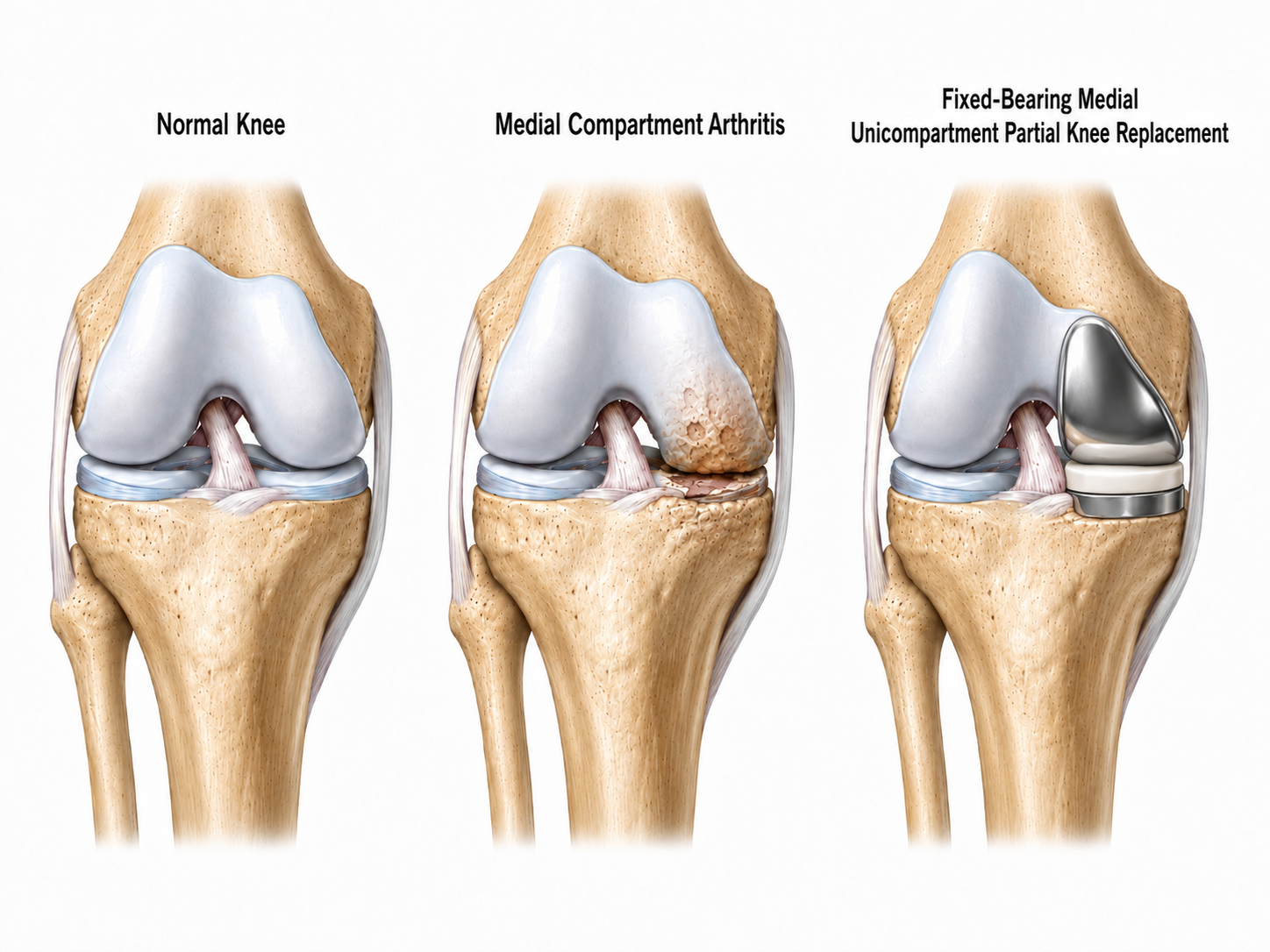
Normal knee, medial compartment arthritis, and a fixed-bearing medial partial knee replacement, compared side by side

Partial Knee Replacement: Five Essential Facts

  • What does it involve: A medial partial knee replacement resurfaces the inner (medial) compartment only. The outer compartment, the kneecap joint and both cruciate ligaments are preserved. Lateral (outer compartment) partial replacement and patellofemoral (kneecap joint) replacement are different operations with different selection criteria, and are not discussed in this section.
  • When is it considered: NICE recommends that people with isolated medial-compartment osteoarthritis who are suitable for either operation are offered a choice between partial and total knee replacement.
  • Reported improvement: Compared with total knee replacement, partial replacement generally offers a faster early recovery and fewer serious medical complications. It often results in higher function and patient satisfaction.
  • How long implants last:  Around 12 in 100 partial replacements had been revised by ten years, compared with around 5 in 100 total replacements. Deaths and serious medical complications were less common after partial replacement.
  • Recovery: Walking is usually quicker than after a total knee replacement. Many patients go home within one to two days, although full recovery takes several months.

I assess patients in the clinic prior to discussing the suitability of the type of surgery. Please find out more about me here.



The knee has three compartments: the inner (medial) side, the outer (lateral) side, and the joint between the kneecap and the thigh bone (patellofemoral). Osteoarthritis often begins in the medial compartment because this side carries most of the load when you stand and walk.

As medial cartilage wears away, the inner joint space narrows, the leg can become slightly bow-legged (varus), and the underlying bone can become painful. The outer compartment and the ligaments may remain healthy for years.

Typical symptoms of medial compartment arthritis

  • Pain focused on the inner side of the knee, often pointed to with one finger.
  • Pain on walking, standing from a chair, or on stairs, particularly going down.
  • Stiffness after sitting, and pain that disturbs sleep.
  • Swelling, grinding, or a sense of the knee giving way.
  • A gradually more bow-legged appearance of the leg.

Symptoms do not always match what is seen on an X-ray. NICE advises that osteoarthritis is often diagnosed clinically, and that routine imaging is not always needed to make the diagnosis. Imaging becomes important when planning surgery.

NICE recommends considering referral for joint replacement when pain, stiffness, reduced function or progressive deformity is substantially affecting quality of life, and non-surgical management has been ineffective or unsuitable. The decision should follow clinical assessment, not an arbitrary numerical score.

Partial knee replacement is then considered when that arthritis is confined to one compartment, most often the medial side, and the rest of the knee is working well.

NICE recommendation 1.7.1 states that a choice of partial or total knee replacement should be offered to people with isolated medial compartmental osteoarthritis, and that the potential benefits and risks of each option should be discussed. NICE quality standard QS206 restates this as a measurable standard of care. At the time NICE published this guidance, partial replacement accounted for about 10% of primary knee replacements nationally, total replacement for about 89%, and patellofemoral replacement for about 1%.

Older selection rules once excluded patients who were younger, heavier or more active. Current national guidance takes a different position. NICE advises that people should not be excluded from referral for joint replacement solely because of age, sex or gender, smoking, other medical conditions, or overweight and obesity. These factors still change your personal risk, so optimisation and an individual discussion remain important. The Swansea Bay University Health Board currently has a cut-off BMI of 40 for elective joint replacement surgery; patients with higher BMI are referred to the weight loss and pre-operative optimisation team.

Non-surgical treatment remains worthwhile whether you are avoiding surgery, waiting for surgery or preparing for it. A combined plan usually works better than any single treatment.

Exercise and activity

Therapeutic exercise is a core treatment. NICE recommends exercise tailored to the individual, including muscle strengthening around the knee and general aerobic fitness. Symptoms can briefly increase when exercise starts. Regular long-term exercise can reduce pain and improve function.

Weight management

If you are living with overweight or obesity, weight loss can reduce pain and improve function and quality of life. NICE advises that any weight loss can help, and that losing around 10% of body weight is likely to yield greater benefit than losing 5% where achievable.

Medicines, injections and walking aids

  • A topical anti-inflammatory (NSAID) gel is recommended first when medication is needed for knee osteoarthritis.
  • An oral NSAID may be considered if topical treatment is ineffective or unsuitable, after reviewing the risks to the stomach, kidneys, liver, and cardiovascular system. Gastroprotection is usually prescribed alongside.
  • Paracetamol and weak opioids are not routinely recommended, except for infrequent short-term use. Strong opioids are not recommended for osteoarthritis.
  • A corticosteroid injection can give short-term relief, usually around 2–10 weeks, and can be used to support an exercise programme.
  • A walking stick used in the opposite hand can reduce load on the arthritic side.

Treatments not routinely recommended

NICE does not recommend hyaluronan injections, glucosamine, strong opioids, acupuncture or dry needling, or arthroscopic lavage and debridement for osteoarthritis. Braces, insoles or supports are not routinely advised unless there is a specific stability or biomechanical problem.

Other surgical options

In a small, selected group, usually younger and more active people with medial arthritis and a bow-legged alignment, an osteotomy may be discussed. This realigns the shin bone to shift load away from the worn side. It preserves the joint but requires a longer, more demanding recovery. In my practice, I do not do osteotomy but refer to an appropriate surgeon in selected cases.

If you decide to wait

Knee osteoarthritis is not usually dangerous. Symptoms may stay similar, fluctuate or worsen. One consideration is specific to partial replacement: if arthritis spreads to the other compartments while you wait, a partial replacement may no longer be an option. Ask for reassessment if pain, walking, deformity or independence changes. Choosing not to have surgery is a valid decision

The operation is performed through a similar but often a smaller incision at the front of the knee than a total replacement.

The worn cartilage and a thin layer of bone are removed from the inner half of the end of the thigh bone (femur) and the top of the shin bone (tibia). A metal femoral component and a metal tibial tray are fitted onto these prepared surfaces, with a plastic (polyethene) bearing seated between them. The outer compartment, the kneecap joint and both cruciate ligaments are left alone.

Fixed-bearing design

Partial knee replacements come in two designs. In a mobile-bearing implant, the plastic insert can slide slightly on the tibial tray. In a fixed-bearing implant, used here, the plastic is locked into the tray and does not move independently. Fixed-bearing designs eliminate the risk of bearing dislocation, a recognised, though uncommon, problem with mobile-bearing implants. Both designs have long records in the National Joint Registry.

Cemented fixation

The components are fixed to the bone with acrylic bone cement, which sets within minutes, immediately securing the implant.

Anaesthesia and pain relief

NICE recommends offering a choice between regional anaesthesia (usually a spinal) and general anaesthesia, combined with local anaesthetic infiltration around the knee. A nerve block that does not significantly weaken the leg may also be considered. Your anaesthetist will discuss the options and your individual risks. Many partial knee replacements are performed under spinal anaesthesia with sedation, which supports early mobilisation and same-day discharge.

Blood loss, infection prevention and implant safety

NICE recommends tranexamic acid for primary elective knee replacement to reduce blood loss, with the dose and route adjusted based on kidney function. Antibiotics are given around the time of surgery and surgical-site infection precautions are followed. NICE also recommends ultra-clean air ventilation for elective joint replacement and two intraoperative pause points to verify implant details and component compatibility.

Documentation and traceability

BOA, BASK and GIRFT best-practice standards set out what should be recorded for every knee arthroplasty: the consent discussion and implant choice, the WHO surgical safety checklist, component sizes and position, the assessment of the other compartments and the ligaments, stability before closure, drugs given, and the rehabilitation and clot-prevention plan.

Because the ligaments and other parts of the joint are preserved, many people report that the knee moves and feels more like their own than after a total replacement.

What is generally reported after partial compared with total replacement

  • Shorter hospital stay, with day-case or next-day discharge common in suitable patients.
  • Less blood loss and a lower likelihood of transfusion.
  • Lower rates of serious early medical complications, including deep infection, blood clots, heart attack, stroke and death.
  • Faster return of movement, with a better bend on average.
  • A higher likelihood of further surgery over the following ten to fifteen years.

These comparisons come mainly from a matched national study that paired 54,215 partial with 54,215 total knee replacements from the National Joint Registry and Hospital Episode Statistics.

Partial replacement also treats only one compartment. Arthritis can progress in the remaining compartments, and that is one of the recognised reasons for later surgery.

Expected or usually temporary effects

  • Pain, bruising, swelling, fatigue and reduced mobility during early recovery.
  • A scar, often with a numb or altered-feeling patch of skin beside it.
  • A need for walking aids and some help at home for a period of time.

Important partial knee replacement information & specific risks

The final decision is sometimes made in theatre

Occasionally, the joint surfaces look different once the knee is opened, for example, with unexpected cartilage loss in the outer compartment. If a partial replacement would not be reliable, the plan changes to a total knee replacement during the same operation. This possibility is discussed and consented for beforehand, so that you are not asked to make a decision under anaesthetic.

Progression of arthritis elsewhere in the knee

Arthritis can develop in the outer compartment or the kneecap joint over the years. This is a common reason for later conversion to a total knee replacement, reported to be about 12 in 100 at 10-year follow-up.

Persistent pain

Some knees continue to hurt despite a well-positioned, well-fixed implant. Assessment should look for a cause before further surgery is considered.

Infection

A superficial wound problem may settle with treatment. Deep infection around an implant can require washout, prolonged antibiotics or revision. Infection after joint replacement is uncommon, and rates after partial replacement are generally lower than after total replacement.

Fracture

An uncommon but recognised complication of partial replacement, related to the bone cuts on the top of the shin bone. It may need fixation or a change of implant.

Blood clot: Deep Vein Thrombosis(DVT) or Pulmonary Embolism(PE)

Early mobilisation and preventive medication reduce, but do not eliminate, the risk. Rates are generally lower than after total knee replacement.

Nerve or blood-vessel injury

Injury to the sciatic or femoral nerve can cause numbness, weakness or foot drop. This is uncommon but can be serious and is not always fully reversible.

Wear, loosening or implant failure

A replacement may eventually need revision surgery. NICE recommends prostheses with revision rates (or projected rates) of 5% or less at 10 years.

Persistent pain

Some people continue to have pain despite a well-positioned implant, sometimes from the tendons and muscles at the side of the hip  and chronic low back rather than the joint itself.

Trochanteric or abductor pain

Pain and tenderness over the bony point at the side of the hip, sometimes with a limp, which usually improves with physiotherapy.

Complex Regional Pain Syndrome

A rare pain condition causing disproportionate pain, swelling, stiffness and sensitivity, which may need specialist treatment.

General surgical and medical risks
  • Bleeding, haematoma or the need for a blood transfusion.
  • Urine retention or urinary infection, chest infection, kidney problems, medication reactions or pressure damage to skin.
  • Heart attack, stroke, serious anaesthetic complication or death. These are uncommon, but personal risk is higher with some medical conditions.

  • Attend pre-operative assessment and give the team a complete list of medical conditions, allergies, medicines, supplements and previous anaesthetic problems.
  • Do not stop blood thinners, diabetes medicines, steroids or immune-modifying treatment unless the surgical team gives you a specific plan.
  • Build strength and stamina within your limits. NICE recommends preoperative rehabilitation advice covering exercise, lifestyle, diet, weight management and smoking cessation.
  • If you smoke, stopping reduces wound, lung and infection risks. Ask for NHS stop-smoking support if needed.
  • If you have diabetes, good blood-glucose control helps reduce complications. Anaemia, poor nutrition and dental infection should be addressed where possible.
  • Tell the team about fever, a new infection, broken skin, ulcers or a worsening wound before admission. Keep the leg skin clean with 2% Chlorhexidine wipes (off-the-shelf) for 2-3 days before surgery.
  • Shower or bathe as instructed. Do not shave or wax the operation area unless specifically told to do so; hospitals use safe hair-removal methods if needed.
  • Prepare your home: clear trip hazards, consider chair and bed height, put frequently used items within easy reach, plan meals, arrange transport and identify someone who can help during the first days.
  • Practise using crutches or a frame beforehand if the physiotherapist offers this.

  1. NICE NG226. Osteoarthritis in over 16s: diagnosis and management. Published 19 October 2022. nice.org.uk/guidance/ng226
  2. NICE NG157. Joint replacement (primary): hip, knee and shoulder. Published 4 June 2020. Shared decision-making, prehabilitation, anaesthesia, tranexamic acid, infection prevention, and partial versus total knee replacement. nice.org.uk/guidance/ng157
  3. NICE QS206. Joint replacement (primary): hip, knee and shoulder quality standard. Published 29 March 2022. nice.org.uk/guidance/qs206
  4. NICE NG89. Venous thromboembolism in over 16s: reducing the risk. Elective knee replacement prophylaxis options. nice.org.uk/guidance/ng89
  5. BOA / BASK / GIRFT. Best Practice for Knee Arthroplasty Surgery Documentation. 2019. boa.ac.uk
  6. BOA / BASK BOAST. Investigation and Management of Patients with Problematic Knee Replacements. August 2020. boa.ac.uk/standards-guidance/boasts.html
  7. BASK and EKS. Price A, Thienpont E, Catani F, Abram S, Troelsen A. Consensus statement on unicompartmental knee replacement: a collaboration between BASK and EKS. The Knee 2023;41:391-396.
  8. National Joint Registry. 22nd Annual Report 2025. Primary and revision outcomes for hip and knee replacement, covering procedures to 31 December 2024. njrcentre.org.uk
  9. Matched national comparison. Burn E, Liddle AD, Hamilton TW, et al. A matched comparison of long-term outcomes of total and unicompartmental knee replacements in different ages based on national databases: analysis of data from the National Joint Registry. J Arthroplasty 2021. Source of the 12% versus 5% ten-year revision figures, the reoperation and mortality comparisons, and the surgeon-volume findings quoted in this guide.
  10. Orthopaedic Data Evaluation Panel. Persona Partial Knee (Zimmer Biomet), cemented, cross-linked polyethylene fixed bearing. ODEP rating 7A*, updated 2025, renewal due 2028. odep.org.uk
  11. NICE resource impact report. Joint replacement (primary): hip, knee and shoulder (NG157), June 2020. Source of the national split of primary knee replacements into total, partial and patellofemoral.
  12. NHS England Digital. [MI] Patient Reported Outcome Measures (PROMs) in England, final 2024/25 data. Released as management information; findings to be treated with caution. digital.nhs.uk
  13. National Joint Registry. Patient Decision Support Tool (hip and knee). njrcentre.org.uk/patients/patient-decision-support-tool