
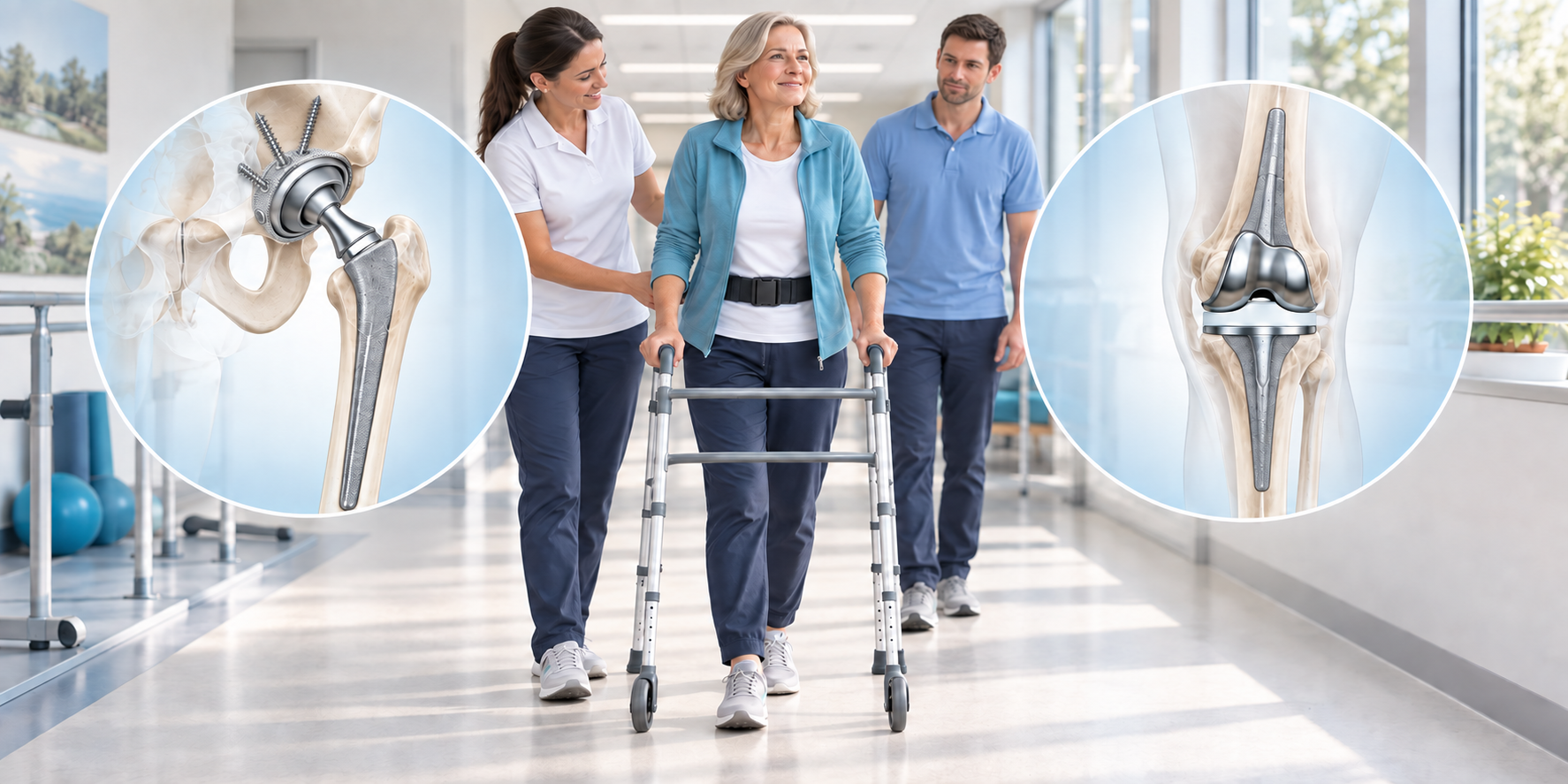
Revision hip and knee replacement
Revision hip and knee replacement is further surgery to change part or all of an existing artificial joint. It may be considered when a hip or knee replacement becomes loose, worn, infected, unstable, fractured or persistently painful for an identifiable reason. Revision surgery ranges from exchanging one component to removing the entire replacement and rebuilding damaged bone with specialist implants.
Why might a joint replacement need revision surgery?
Modern joint replacements usually provide many years of pain relief and improved mobility. Occasionally, however, the implant or the tissues around it develop a problem. Common reasons include aseptic loosening, bearing-surface wear, recurrent hip dislocation, knee instability, stiffness, periprosthetic joint infection and a fracture around an existing replacement. Persistent pain alone is not enough to justify another operation: the cause should be investigated carefully before treatment is recommended.
Assessment may include examination, comparison of current and previous X-rays, blood tests for inflammation, aspiration of the joint when infection is possible, and CT or other imaging when bone loss needs to be defined. Implant details and records from the original operation are also valuable. The British Orthopaedic Association guidance on problematic knee replacements supports a structured, consultant-led assessment, while suspected acute infection requires prompt evaluation in line with BOA guidance on periprosthetic joint infection.
Planning revision hip and knee replacement
Every revision is planned individually. The operation depends on why the original replacement failed, whether infection is present, how firmly the components remain fixed, and the quality of the remaining bone, muscles and ligaments. Surgery may require longer stems, bone graft, metal augments, cones, sleeves or a more constrained implant. Complex cases benefit from multidisciplinary planning and access to appropriate implants, microbiology, anaesthetic and critical-care support.
Revision surgery generally carries greater risks and a less predictable recovery than first-time joint replacement. Nevertheless, many patients achieve worthwhile pain relief, safer walking and improved independence. Outcomes and the possibility of further surgery should be discussed honestly; the National Joint Registry annual report provides UK information about joint-replacement activity and revision outcomes.
Related patient guides
Continue with the expandable sections below for detailed patient information about revision hip and knee replacement. You can also read the dedicated revision hip and knee replacement recovery guide. Information about first-time operations is available on the total hip replacement and total knee replacement pages.